RESEARCH STATEMENT
I study the {responsible application, development, impact} of AI in digital consumer and e-commerce analytics with a focus on text data. Specific interests are:
I run the BIT (Business Insights through Text) Lab (link). Co-founder and Co-lead of BU Digital Business Institute Generative AI Lab
Research streams by topic are described below (click to expand).
Editorial Roles:
Associate Editor at Management Science
Associate Editor at Information Systems Research
Editorial Board at Marketing Science
I study the {responsible application, development, impact} of AI in digital consumer and e-commerce analytics with a focus on text data. Specific interests are:
- Generative AI (unintended consequence and human-integration frictions)
- Economics of unstructured data (content extraction, understanding, engineering, marketing)
- Unintended Consequence of AI in Business
I run the BIT (Business Insights through Text) Lab (link). Co-founder and Co-lead of BU Digital Business Institute Generative AI Lab
Research streams by topic are described below (click to expand).
Editorial Roles:
Associate Editor at Management Science
Associate Editor at Information Systems Research
Editorial Board at Marketing Science
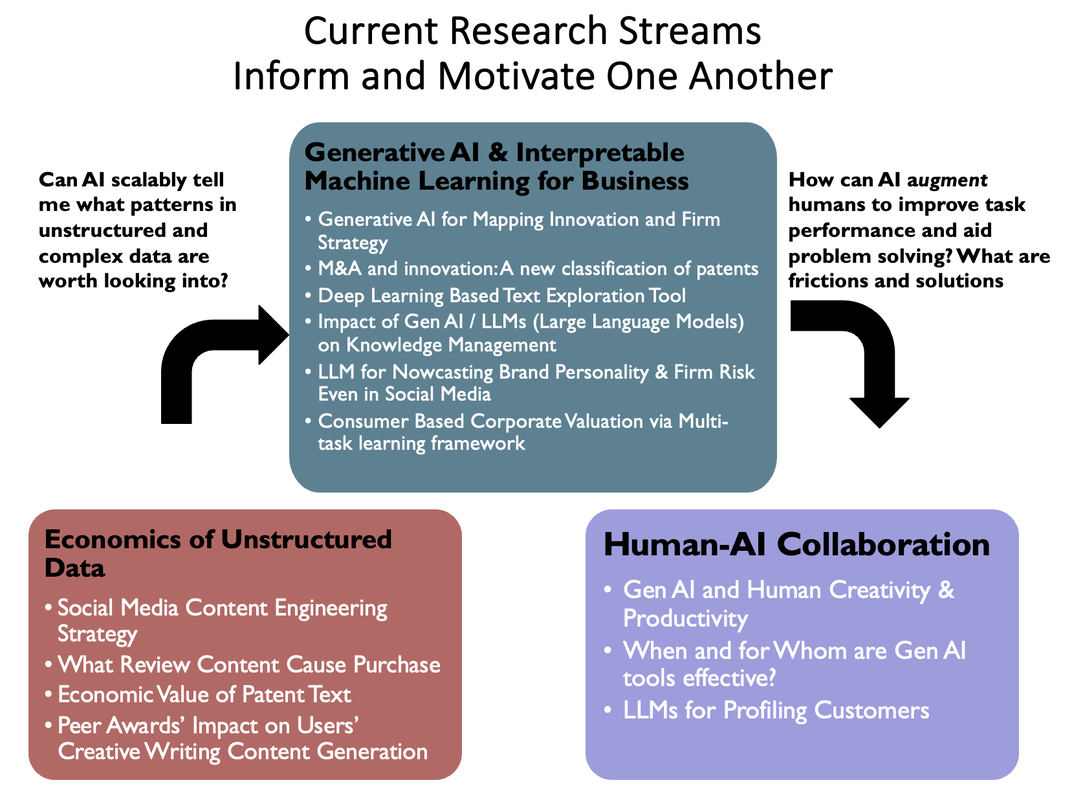
1. Generative AI & Interpretable Machine Learning for Business
Several papers in the impact and application of generative AI in Business:
In addition, widely spread blackbox ML algorithms (e.g., neural nets) do not provide rationale for predictions and are often hard to understand. Consequently, issues involving unintended biases, auditability, trust are emerging in all sectors. In this stream, I develop interpretability-focused algorithms for business applications such as: automatic concept extractor for exploring text data, disentangling factors of technological innovation from patent data, churn prediction model to capture and describe nonlinear consumer-level time series patterns, and a conceptual framework of good explanation for algorithmic transparency, and more with the goal of applying or developing the latest ML models to solve business problems while focusing on interpretability to overcome aforementioned issues.
Representative Papers: Guided Diverse Concept Miner, InnoVAE
- Generative AI & Human Creativity [Presentation Video]
- Use of Generative AI to Map out Competitive Landscape [Presentation Video]
- Impact of ChatGPT on Knowledge Sharing Websites
- LLM to Nowcast Corporate Risk Event
- Consumer Based Corporate Valuation Via Multi-Tasking Framework
- Guided Diverse Concept Miner [github]
In addition, widely spread blackbox ML algorithms (e.g., neural nets) do not provide rationale for predictions and are often hard to understand. Consequently, issues involving unintended biases, auditability, trust are emerging in all sectors. In this stream, I develop interpretability-focused algorithms for business applications such as: automatic concept extractor for exploring text data, disentangling factors of technological innovation from patent data, churn prediction model to capture and describe nonlinear consumer-level time series patterns, and a conceptual framework of good explanation for algorithmic transparency, and more with the goal of applying or developing the latest ML models to solve business problems while focusing on interpretability to overcome aforementioned issues.
Representative Papers: Guided Diverse Concept Miner, InnoVAE
2. Economics of Unstructured Data (Content Extraction, Understanding, Engineering, and Marketing)
70-90% of data growth is due to the unstructured data (e.g., texts, images) with much insights still unlocked. In this stream, I measure the economic impact of unstructured data in e-commerce and digital economy. The papers in this stream investigates: what advertising content in social media engage consumers better, what product review content in e-commerce cause conversion, what are factors of technological innovations found in patent text data, what image features are correlated with high demand in lodging market, how do cyberbullying influence Q&A platform and user-contribution, etc. These papers first identify meaningful content by motivating them from theories in consumer behavior, marketing, and economics. Then I apply ML techniques to extract content at scale followed by causal inference to quantify the economic impact of identified content. With these insights, I explore content engineering strategies.
Representative Papers: Facebook Advertising Content Paper, AirBNB and Image Paper, What Review Content Cause Purchase
Representative Papers: Facebook Advertising Content Paper, AirBNB and Image Paper, What Review Content Cause Purchase
3. Unintended Consequence of algorithms and Nudges
Algorithms such as recommender systems have been instrumental in e-commerce settings for increasing sales for retailers and finding new products for consumers. But in this stream of research, I find that popular algorithms such as collaborative filters suffer from unintended consequence of increasing aggregate retailer level sales concentration. On a separate study, different nudges in mobile micro-giving setting is examined.
Journal PAPER LIST
Conference with Proceedings
- Joy Lu Tong, Dokyun Lee, Taewan Kim, David Danks (2020) “Good Explanation for Algorithmic Transparency”, AAAI-AIES, New York, USA. (Oral presentation 35/211)
- Gordon Burtch, Qinglai He, Yili Hong, Dokyun Lee, (2019) Peer Symbolic Awards Increase User Content Generation but Reduce Content Novelty,” International Conference in Information Systems (ICIS)
- Xiao Liu, Dokyun Lee and Kannan Srinivasan, (2018) “Deep Learning of Consumer Review Content,” 2018. Proceedings of the AAAI
- Dongwon Lee, Anandasivam Gopal, Dokyun Lee. (2017) “Micro-Giving: On the Use of Mobile Devices and Monetary Subsidies in Charitable Giving”., International Conference in Information Systems (ICIS) Seoul, South Korea. Best Conference Paper Winner.
- Dokyun Lee, Kartik Hosanagar. (2016) “When do Recommender Systems Work the Best? The Moderating Effects of Product Attributes and Consumer Reviews on Recommender Performance”, International World Wide Web Conference (WWW Conference), Montreal, Canada
- Shunyuan Zhang, Dokyun Lee, Param Vir Singh, Kannan Srinivasan (2016) “How Much Is An Image Worth? An Empirical Analysis of Property’s Image Aesthetic Quality on Demand at AirBNB”, International Conference in Information Systems (ICIS), Dublin, Ireland.
- Xiao Liu, Dokyun Lee, Kannan Srinivasan. (Dec 2016) " The Effect of Consumer Review Content on Sales Conversion: Analysis of Consumer Information Journey Across Categories with Deep Learning", NET Institute Conference at NYU, New York, USA
- Dokyun Lee and Kartik Hosanagar (2014) “People Who Liked This Study Also Liked: The Impact of Recommender Systems on Sales Volume and Diversity”, International Conference in Information Systems (ICIS), eBusiness, Auckland, New Zealand
CONFERENCE Presentations
- Zhaoqi Cheng, Dokyun Lee, Prasanna Tambe “Robot Inventors? Patents, Generative Algorithms, and Innovation Frontiers”, WISE, Virtual Conference [BEST STUDENT PAPER]
- Zhaoqi Cheng, Dokyun Lee, Prasanna Tambe “Can AI Innovate? Interpretable Generative Model of Patents”, INFORMS CIST, Virtual Conference
- Zhaoqi Cheng, Dokyun Lee, Prasanna Tambe “Can AI Innovate? Interpretable Generative Model of Patents”, INFORMS Data Science Workshop, Virtual Conference. [Runner Up, Best Student Paper]
- Emaad Manzoor, George Chen, Dokyun Lee, Michael Smith (2020) “Persuasion under Cognitive Overload — Heuristic-Systematic Tradeoffs in Information Design?”, INFORMS CIST, Virtual Conference
- Dokyun Lee, Eric Zhou, Chengfeng Mao (2020), “Augmenting Hypothesis Development Through Interpretable Machine Learning”, MISQ Author’s Workshop, Virtual Workshop
- Emaad Manzoor, George Chen, Dokyun Lee, Michael Smith (2020) “Persuasion under Cognitive Overload — Heuristic-Systematic Tradeoffs in Information Design?”, Stanford Conference on Computational Sociology, Virtual Conference
- Emaad Manzoor, George Chen, Dokyun Lee, Michael Smith (2020) “Persuasion under Cognitive Overload — Heuristic-Systematic Tradeoffs in Information Design?”, International Conference on Computational Social Science, Virtual Conference.
- Emaad Manzoor, Dokyun Lee, George Chen, Alan Montgomery (2020) “D(opinion)/d(argument)- Quantifying Strategic Persuasion On Gun Control Debates”, Statistical Challenges in E-Commerce, Spain, Madrid.
- Emaad Manzoor, George Chen, Dokyun Lee, Michael Smith (2020) “Equitable Persuasion in Incentivized Deliberation — An Impossible Tradeoff?”, Statistical Challenges in E-Commerce, Spain, Madrid.
- Emaad Manzoor, George Chen, Dokyun Lee, Michael Smith (2020) “Persuading under Information Overload: Identifying the Effect of Heuristic Signals in Online Argumentation”, Marketing Science Conference, Durham, USA.
- Samuel Levy, Dokyun Lee, Daniel McCarthy, Alan Montgomery (2020) “Multi-view Topic Model For Purchase Prediction”, Marketing Science Conference, Durham, USA.
- Emaad Manzoor, Dokyun Lee, George Chen, Alan Montgomery (2020) “D(opinion)/d(argument)- Quantifying Strategic Persuasion On Gun Control Debates”, Marketing Science Conference, Durham, USA.
- Dokyun Lee, Emaad Manzoor, and Zhaoqi Cheng (Jan 2020) “Focused Concept Miner (FCM): an Interpretable Deep Learning for Text Exploration”, Wharton Behavioral Insights from Text, Philadelphia, USA
- Gordon Burtch, Qinglai He, Yili Hong, Dokyun Lee, (Dec 2019) “Peer Symbolic Awards Increase User Content Generation but Reduce Content Novelty,” International Conference in Information Systems (ICIS), Munich, Germany.
- Joy Lu Tong, Dokyun Lee, Taewan Kim, David Danks (Dec 2019) “A Framework of Good Explanation For Machine Learning Output”, ICIS-KRAIS, Munich, Germany.
- Dokyun Lee, Emaad Manzoor, and Zhaoqi Cheng (Dec 2019) “Focused Concept Miner (FCM): an Interpretable Deep Learning for Text Exploration”, ICIS-KRAIS, Munich, Germany
- Gordon Burtch, Qinglai He, Yili Hong, Dokyun Lee, (2019) “Peer Symbolic Awards Increase User Content Generation but Reduce Content Novelty,” Conference On Digital Experimentation (CODE@MIT), Boston United States.
- Dokyun Lee, Emaad Manzoor, and Zhaoqi Cheng (2019) “Focused Concept Miner (FCM): an Interpretable Deep Learning for Text Exploration”, INFORMS, Seattle, United States
- Emaad Ahmed Manzoor, Dokyun Lee, George Chen, Alan Montgomery (2019) “Quantifying Strategic Persuasion — Measuring d(opinion)/d(argument) in Debates on Gun Control”, INFORMS Seattle, United States.
- Zhaoqi Cheng, Dokyun Lee, Tridas Mukhpadhyay (2019) “Do Aggressive Comments Bring Better Questions? Evidence from Stack Overflow,” INFORMS 14th INFORMS Workshop on Data Mining and Decision Analytics Seattle, United States.
- Emaad Ahmed Manzoor, Dokyun Lee, George Chen, Alan Montgomery (2019) “Quantifying Strategic Persuasion — Measuring d(opinion)/d(argument) in Debates on Gun Control”, Conference of Information Systems and Technology (CIST), Seattle, United States.
- Emaad Ahmed Manzoor, Dokyun Lee, George Chen, Alan Montgomery (2019) “Quantifying Persuasion in Argumentative Dialogue - Evidence from Debates on Gun Control”, INFORMS Workshop on Data Science Seattle, United States.
- Gordon Burtch, Qinglai He, Yili Hong, Dokyun Lee, (2019) “Peer Symbolic Awards Increase User Content Generation but Reduce Content Novelty,” Conference of Information Systems and Technology (CIST), Seattle, United States.
- Zhaoqi Cheng, Dokyun Lee, Tridas Mukhpadhyay (2019) “Do Aggressive Comments Bring Better Questions? Evidence from Stack Overflow,” INFORMS Workshop on Data Science Seattle, United States.
- Joy Lu Tong, Dokyun Lee, Taewan Kim, David Danks (July 2019) “What is a Good Explanation in the Context of Artificial Intelligence? A Human's Guide to Understanding and Using Machine Learning Output”, Joint Statistical Meetings, Colorado, USA.
- Gord Burtch, Qinglai He, Yili Hong, Dokyun Lee, (June 2019) “The Role of Peer Symbolic Awards on User-Generated Content Creativity: Evidence from a Randomized Field Experiment” Statistical Challenges in E-Commerce, Hong Kong.
- Emaad Ahmed Manzoor, Dokyun Lee, George Chen, Alan Montgomery (June 2019) “Quantifying Persuasive Dialogue via Belief Hierarchies”, Marketing Science Conference, Rome, Italy.
- Joy Lu Tong, Dokyun Lee, Taewan Kim, David Danks (June 2019) “What is a Good Explanation in the Context of Artificial Intelligence? A Human's Guide to Understanding and Using Machine Learning Output”, Marketing Science Conference, Rome, Italy.
- Dokyun Lee, Emaad Manzoor, and Zhaoqi Cheng (June 2019) “Focused Concept Miner (FCM): an Interpretable Deep Learning for Text Exploration”, Marketing Science Conference, Rome, Italy.
- Dokyun Lee, Emaad Manzoor, and Zhaoqi Cheng (June 2019) “Focused Concept Miner (FCM): an Interpretable Deep Learning for Text Exploration”, Choice Symposium, Maryland, USA.
- Gord Burtch, Qinglai He, Yili Hong, Dokyun Lee, (May 2019) “The Role of Peer Symbolic Awards on User-Generated Content Creativity: Evidence from a Randomized Field Experiment” Workshop on Experimental and Behavioral Economics in IS (WEBEIS 2019), Minneapolis, USA.
- Dokyun Lee, Emaad Manzoor, and Zhaoqi Cheng (Dec 2018) “Focused Concept Miner (FCM): an Interpretable Deep Learning for Text Exploration”, Conference on Digital Marketing and Machine Learning, Pittsburgh, United States.
- Dokyun Lee, Emaad Manzoor, and Zhaoqi Cheng (Nov 2018) “Focused Concept Miner (FCM): an Interpretable Deep Learning for Text Exploration”, Conference on Information Systems and Technology, INFORMS, Pheonix, AZ, United States.
- Dokyun Lee, Emaad Manzoor, and Zhaoqi Cheng (June 2018) “Focused Concept Miner (FCM): an Interpretable Deep Learning for Text Exploration”, Marketing Science Conference, Philadelphia, United States.
- Zijun (June) Shi, Dokyun Lee, Param Vir Singh, Kannan Srinivasan (June 2018) “Design of Fashion: Can Brand Value be Seprated From Style Value?”, Marketing Science Conference, Philadelphia, United States.
- Nikhil Malik, Param Singh, Dokyun Lee, and Kannan Srinivasan (June 2018) “When Does Beauty Pay? A Large Scale Image Based Appearance Analysis on Career Transitions”, Marketing Science Conference, Philadelphia, United States.
- Dongwon Lee, Anandasivam Gopal, Dokyun Lee. “Micro-Giving: On the Use of Mobile Devices and Monetary Subsidies in Charitable Giving” (June 2018). Marketing Science Conference, Philadelphia, United States.
- Dongwon Lee, Anandasivam Gopal, Dokyun Lee. “Micro-Giving: On the Use of Mobile Devices and Monetary Subsidies in Charitable Giving”., Academy of Management Meeting, Chicago, USA. [WINNER BEST STUDENT PAPER AWARD 2018]
- Dongwon Lee, Anand Gopal and Dokyun Lee. (Feb 2018) “Micro-Giving: On the Use of Mobile Devices and Monetary Subsidies in Charitable Giving”, Digital Innovations, Transformations, and Society (DIGITS), India.
- Xiao Liu, Dokyun Lee, Kannan Srinivasan (Feb 2018) “Large Scale Cross-Category Analysis of Consumer Review Content on Sales Conversion Leveraging Deep Learning” (Poster), AAAI 2018 Conference workshop W2: AI and Marketing Science, New Orleans, USA
- Yijin Kim, Dokyun Lee, Hui Li (December 2017) "The Impact of Airbnb on the Residential Real Estate Market: Aggregate and Micro Level Analyses”, Workshop on Information Systems and Economics (WISE), Seoul, South Korea.
- Shunyuan Zhang, Dokyun Lee, Param Vir Singh, Kannan Srinivasan (December 2017) "The Sharing Effects of Sharing Economy: Evidence from a Natural Experiment Involving Airbnb and Uber/Lyft”, Workshop on Information Systems and Economics (WISE), Seoul, South Korea.
- Nikhil Malik, Param Singh, Dokyun Lee and Kannan Srinivasan (October 2017) “When Does Beauty Pay? A Large Scale Image Based Appearance Analysis on Career Transitions”, Conference of Information Systems and Technology (CIST), Houston, United States.
- Dongwon Lee, Anand Gopal and Dokyun Lee. (October 2017) “Micro-Giving: On the Use of Mobile Devices and Monetary Subsidies in Charitable Giving”, Conference of Information Systems and Technology (CIST), Houston, United States.
- Shunyuan Zhang, Dokyun Lee, Param Vir Singh, Kannan Srinivasan (October 2017) "The Sharing Effects of Sharing Economy: Evidence from a Natural Experiment Involving Airbnb and Uber/Lyft”, Conference of Information Systems and Technology (CIST), Houston, United States.
- Shunyuan Zhang, Dokyun Lee, Param Vir Singh, Kannan Srinivasan (Sept 2017) “How Much Is An Image Worth? An Empirical Analysis of Property’s Image Aesthetic Quality on Demand at AirBNB”, Marketing Analytics and Big Data Conference at Columbia University, New York, USA
- Xiao Liu, Dokyun Lee, Kannan Srinivasan. (June 2017) "Large Scale Cross Category Analysis of Consumer Review Content on Sales Conversion Leveraging Deep Learning", Summer Institute in Competitive Strategy at UC Berkeley (SICS), Berkeley, USA.
- Dokyun Lee, Kartik Hosanagar (June 2017) “When do Recommender Systems Work the Best? The Moderating effects of Product Attributes and Consumer Reviews.”, INFORMS Marketing Science Conference (USC), Los Angeles, USA.
- Xiao Liu, Dokyun Lee, Kannan Srinivasan. (June 2017) "Large Scale Cross Category Analysis of Consumer Review Content on Sales Conversion Leveraging Deep Learning", INFORMS Marketing Science Conference (USC), Los Angeles, USA.
- Shunyuan Zhang, Dokyun Lee, Param Vir Singh, Kannan Srinivasan (June 2016) “How Much Is An Image Worth? An Empirical Analysis of Property’s Image Aesthetic Quality on Demand at AirBNB”, INFORMS Marketing Science Conference (USC), Los Angeles, USA.
- Xiao Liu, Dokyun Lee, Kannan Srinivasan. (May 2017) "Large Scale Cross Category Analysis of Consumer Review Content on Sales Conversion Leveraging Deep Learning", Customer Insights Conference at Yale School of Management, Connecticut, USA
- Xiao Liu, Dokyun Lee, Kannan Srinivasan. (May 2016) "Large Scale Cross Category Analysis of Consumer Review Content on Sales Conversion Leveraging Deep Learning", Wharton Customer Analytics Initiative, Philadelphia, USA.
- Xiao Liu, Dokyun Lee, Kannan Srinivasan. (Dec 2016) " The Effect of Consumer Review Content on Sales Conversion: Analysis of Consumer Information Journey Across Categories with Deep Learning", NET Institute Conference at NYU, New York, USA
- Xiao Liu, Dokyun Lee, Kannan Srinivasan. (Dec 2016) "The Effect of Word of Mouth on Sales: New Answers from the Consumer Journey Data with Deep Learning", Stanford Digital Marketing Conference, San Francisco, USA.
- Dongwon Lee, Anandasivam Gopal, Dokyun Lee, Jay Chung (2016) “Mobile Generosity: On the Use of Mobile Devices and Monetary Subsidies in Charitable Giving”, Workshop on Information Systems and Economics (WISE), Dublin, Ireland
- Shunyuan Zhang, Dokyun Lee, Param Vir Singh, Kannan Srinivasan (2016) “Feature Extraction and Demand Estimation on Airbnb: A Deep Learning Approach”, Workshop on Information Systems and Economics (WISE), Dublin, Ireland
- Dongwon Lee, Anandasivam Gopal, Dokyun Lee (2016) “Mobile Generosity: On the Use of Mobile Devices and Monetary Subsidies in Charitable Giving”, Conference on Digital Experimentation at MIT (CODE Conf), Boston, USA.
- Shunyuan Zhang, Dokyun Lee, Param Vir Singh, Kannan Srinivasan (2016) “Professional versus Amateur Images: Investigating Differential Impact on Airbnb Property Demand”, INFORMS CIST, Nashville, USA. [WINNER BEST STUDENT PAPER AWARD AT CIST 2016]
- Shunyuan Zhang, Dokyun Lee, Param Vir Singh, Kannan Srinivasan (2016) “How Much Is An Image Worth? An Empirical Analysis of Property’s Image Aesthetic Quality on Demand at AirBNB”, International Conference in Information Systems (ICIS), Dublin, Ireland.
- Dokyun Lee, Kartik Hosanagar (2016) “When do Recommender Systems Work the Best? The Moderating effects of Product Attributes and Consumer Reviews.”, 12th Symposium on Statistical Challenges in eCommerce Research (SCECR), Naxos Island, Greece.
- Xiao Liu, Dokyun Lee, Kannan Srinivasan. (2016) “Confusion or Conversion? The Role of Product Reviews on Consumer Online and Mobile Purchase Journeys”, INFORMS Society for Marketing Science, Shanghai, China
- Dokyun Lee, Kartik Hosanagar. (2016) “When do Recommender Systems Work the Best? The Moderating Effects of Product Attributes and Consumer Reviews on Recommender Performance”, International World Wide Web Conference (WWW Conference), Montreal, Canada
- Dokyun Lee, Kartik Hosanagar. (2015) “When do Recommender Systems Work the Best? The Moderating Effects of Product Attributes and Consumer Reviews on Recommender Performance”, Conference of Information Systems and Technology (CIST), Philadelphia, United States.
- Dokyun Lee, Kartik Hosanagar. (2015) “When do Recommender Systems Work the Best? The Moderating Effects of Product Attributes and Consumer Reviews on Recommender Performance”, INFORMS, Philadelphia, United States.
- Dokyun Lee, Kartik Hosanagar. (2015) “People Who Liked This Study Also Liked: The Impact of Recommender Systems on Sales Volume and Diversity”, INFORMS, Philadelphia, United States.
- Dokyun Lee, Kartik Hosanagar, and Harikesh Nair. (2014) “The Effect of Social Media Marketing Content on Consumer Engagement: Evidence from Facebook.”, Workshop on Information Systems and Economics (WISE), Auckland, New Zealand [RUNNER UP, BEST STUDENT PAPER AWARD]
- Dokyun Lee and Kartik Hosanagar (2014) “People Who Liked This Study Also Liked: The Impact of Recommender Systems on Sales Volume and Diversity”, International Conference on Information Systems (ICIS), eBusiness, Auckland, New Zealand
- Dokyun Lee, Kartik Hosanagar, and Harikesh Nair. (2014) “The Effect of Social Media Marketing Content on Consumer Engagement: Evidence from Facebook.”, INFORMS, eBusiness, The Social Crowd: New Research in Social Media and Crowdsourcing. Invited Talk, San Francisco, US.
- Dokyun Lee, Kartik Hosanagar. (2014) “People Who Liked This Study Also Liked: The Impact of Recommender Systems on Sales Volume and Diversity”, Conference on Digital Experimentation at MIT (CODE Conf), Boston, US.
- Dokyun Lee, Kartik Hosanagar, and Harikesh Nair. (2013) “Impact of Social Media Content on Consumer Engagement on Facebook: Application of Large- Scale Content Coding.”, Workshop on Information Technology and Systems (WITS, ICIS), Milan, Italy.
- Dokyun Lee, Kartik Hosanagar, and Harikesh Nair. (2013) “The Effect of Social Media Marketing Content on Consumer Engagement: Evidence from Facebook.”, 8th Symposium on Statistical Challenges in eCommerce Research (SCECR), Lisbon, Portugal.
- Dokyun Lee, Shawndra Hill, Justin Vastola. (2011) “Propensity Score Method in Network Data: A Simulation Study of Bias”, Accepted at Workshop on Information Technology and Systems (WITS, ICIS), Shanghai, China.